
May 28, 2026
PU, Acrylic, Laminate or Veneer: an honest comparison
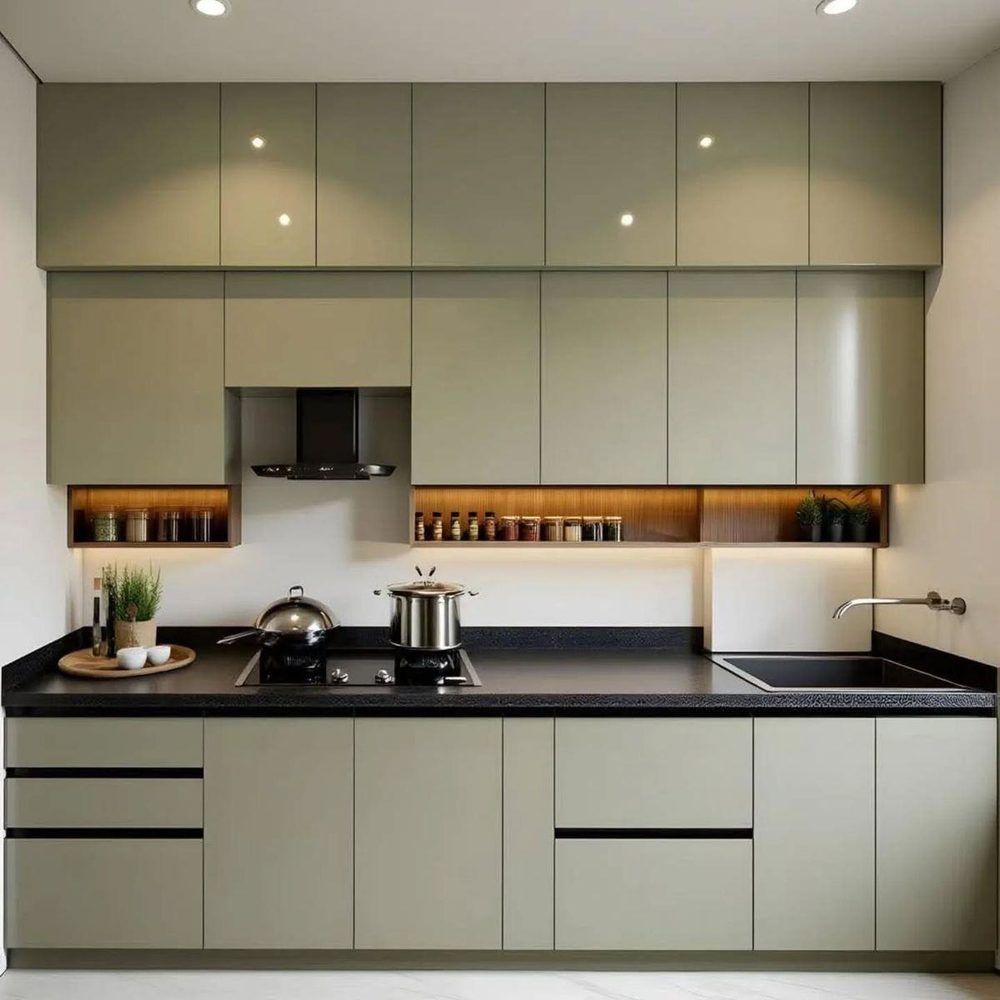
Every client meeting reaches the same crossroads: four finish samples on the table, four very different price tags, and a lot of confident opinions. Here is the comparison we give our own families.
Laminate: the workhorse
Pre-printed sheets pressed onto board. Economical, scratch-hardy, hundreds of prints. Its weakness is the edge: a visible band glued around each shutter that can lift with moisture and time. You'll never mistake it for paint, because it isn't.
Acrylic: the shine merchant
A high-gloss sheet with genuine mirror depth. But it shares the laminate's edge-band anatomy, scratches show readily, and whites can yellow. Damage one shutter and you replace the shutter; there is no repair.
Veneer: the natural aristocrat
Real wood, real grain, real warmth, and real sensitivity. Veneer needs skilled polishing (often PU-based itself), careful moisture management, and periodic re-finishing to hold its colour.
PU: the sprayed system
Not a sheet, but a six-layer coating sprayed over every face and edge, then oven-cured. That single fact drives every advantage:
- Seamless edges. Nothing to lift, peel or catch grime: the coat wraps the shutter.
- Any colour. 200+ tintable shades in matte, satin or gloss, not a printed catalogue.
- Repairable. A deep scratch can be spot-filled and re-sprayed to invisible.
- Profile freedom. Fluted, shaker, arch: coatings follow curves; sheets can't.
Choose laminate for budget, veneer for grain, acrylic for one glossy wall, and PU when the whole room has to feel made, not bought.
The fair caveat: PU done badly (thin coats, no oven, dusty room) is worse than laminate done well. The system is only as good as the booth it's sprayed in. Ask any vendor to show you theirs; we'll happily show you ours.